What kind of science do we need to navigate the crises of the 21st century? In our new article published in Royal Society Open Science, we argue that the answer lies in embracing a richer, more situated understanding of knowledge—one that takes seriously the partiality of perspectives and the challenge of integrating diverse, and sometimes incommensurable, ways of seeing the world.
Drawing on epistemology, complexity science, and our experiences in democratic citizen science, we propose a shift from an industrial model of research—focused on outputs, efficiency, and consensus—toward an ecological model of inquiry. This alternative vision emphasizes diversity, deliberation, and long-term robustness. It reframes citizen science not as an auxiliary to academic research, but as a model for a more inclusive and deliberative scientific practice.
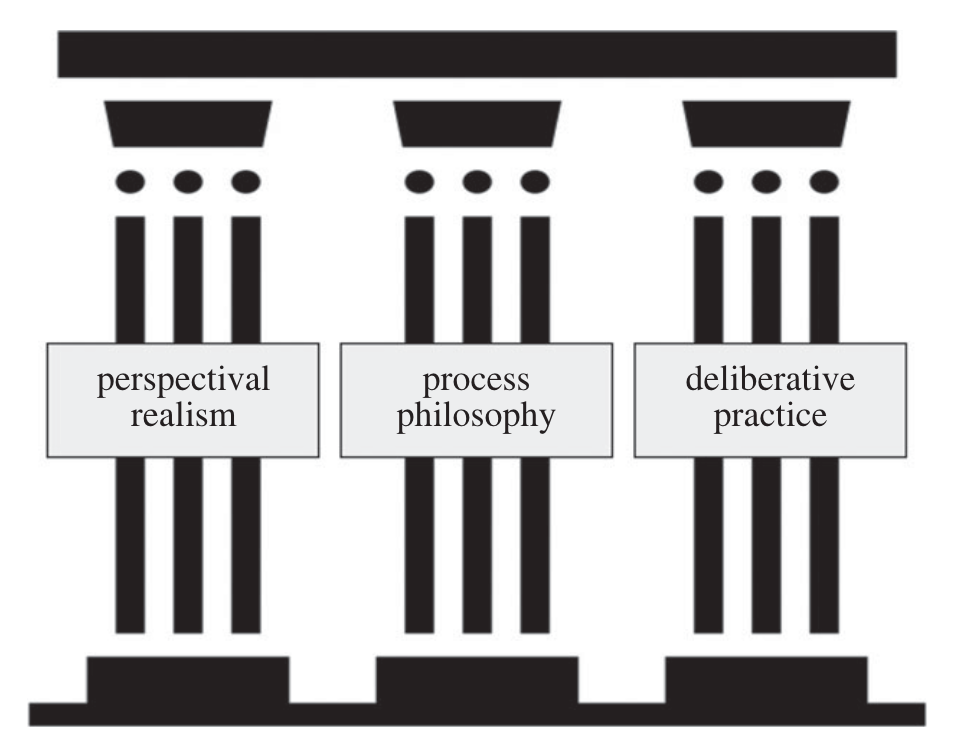
At the heart of our proposal are three epistemic pillars:
- Perspectival realism, which acknowledges that all knowledge is perspectival—shaped by the standpoint, tools, and goals of those producing it—and that science advances by comparing, translating, and at times holding open irreducibly different perspectives.
- Process epistemology, which shifts attention from final results to the unfolding of inquiry itself: how questions are framed, how disagreements are negotiated, and how knowledge is co-produced.
- Deliberative practice, which treats disagreement not as noise to be eliminated but as a generative part of collective intelligence.
This epistemological reorientation has far-reaching consequences. It requires us to assess scientific quality not solely by outputs or metrics, but by the quality of the inquiry process—its openness, its responsiveness to context, and its capacity to accommodate disagreement and surprise.
We argue that democratic citizen science, when designed with these principles in mind, can offer a powerful model for doing science differently. By bringing together multiple ways of knowing, it enriches our understanding of complex issues and helps reveal blind spots that single perspectives often miss.
The path toward an ecological model of science won’t be easy. But by valuing partial perspectives, and creating space for deliberation between them, we can build a more adaptive, democratic, and socially relevant scientific enterprise.
📄 Read the full article: An epistemology for democratic citizen science
 Marc Santolini
One thought on “Rethinking Science from the Ground Up”