On resonance

Jule Timm interviewed me as part of her MA research at Aalto University on resonance in artistic practice. Starting from resonance singing — a collective vocal practice I have been developing for exploring emergence in groups — the conversation ranged across the physics of resonance, somatic practice, Tibetan dharma art, Balinese ritual theater, and the conditions under which art might be designed to truly resonate.

Jule Timm is a Helsinki-based artist and designer whose practice explores the connections between physical, emotional, and ecological bodies — working with sound, textiles, found materials, and the body as a site of listening and resonance. She is currently completing her MA in Contemporary Design at Aalto University. I met her at the Pedagogies of Togetherness gathering at Aalto last November, where we were working together on the design of a curriculum and the recording of practices. Her thesis research on resonance in art and permaculture led us to reconnect for this conversation about the social art practice of resonance singing, which I have been researching and experimenting with over the past years around questions of collective emergence. What follows is a lightly edited transcript — which turned out to be useful for my own sense-making as much as hers.
Continue reading

Exploring the role of care in educational systems

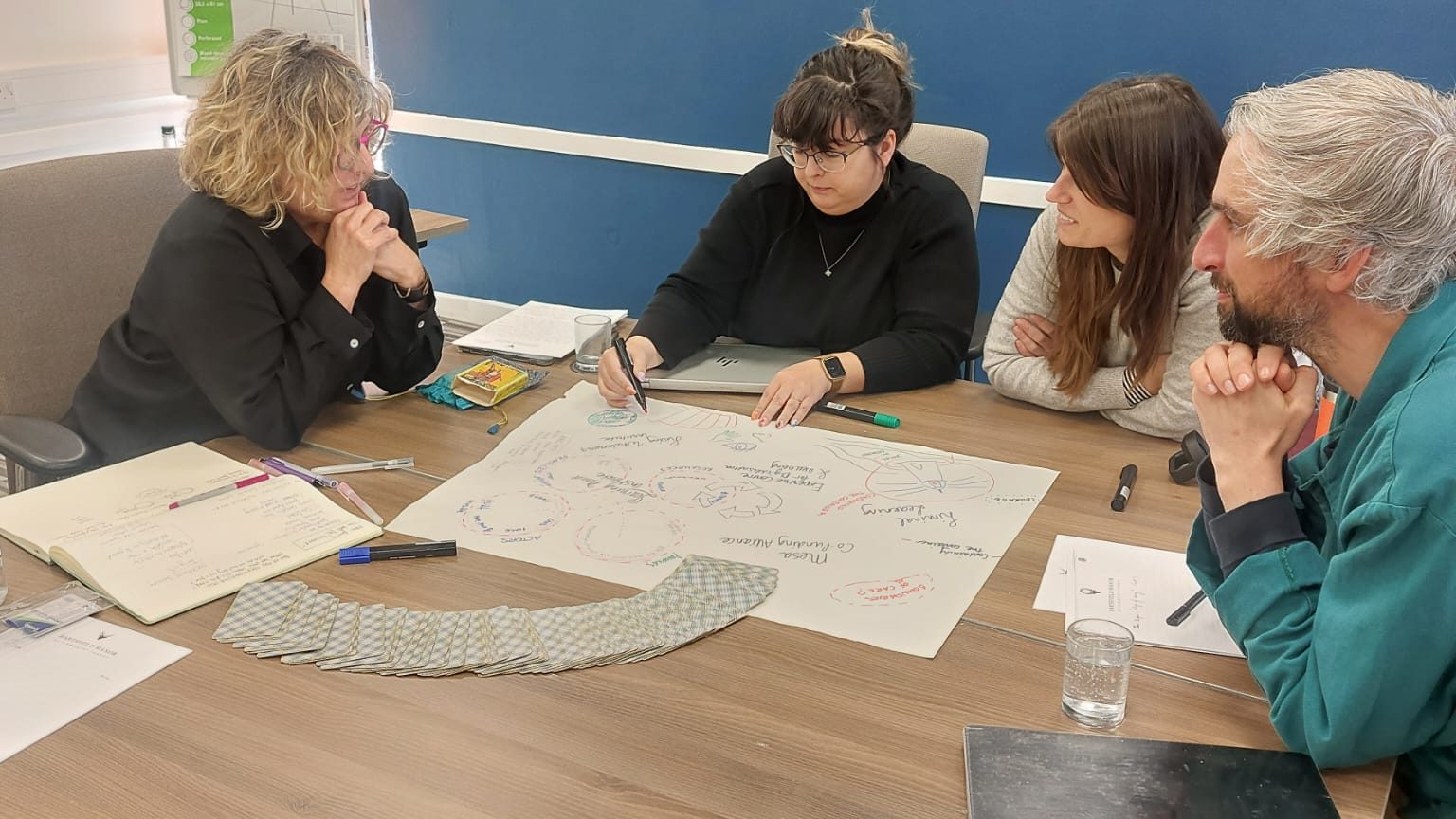
Team-based problem framing with Bloombox tools during the gathering.

Over the past weeks, I found myself moving between two different and deeply connected spaces in the UK.

At the University of Cambridge, I gave a talk at the THRiVE research group on participatory and embodied approaches to learning. A few days later, I joined the Bloombox gathering, a small retreat bringing together educators, researchers, and theologians to explore care and the deeper purposes of education.

One space was structured around research, methods, and conceptual clarity. The other unfolded through dialogue, presence, and shared inquiry. Beneath these differences, both seemed to circle the same question:

How do we learn — and design systems — not only to solve problems, but to remain together in the face of difference, uncertainty, and conflict?

Continue reading

The Art & Science of Collective Intelligence: Podcast interview on R&D Unplugged

How can we foster collective intelligence in times of uncertainty, fragmentation, and crisis?

I had the pleasure of being interviewed on the R&D Unplugged Podcast by the Learning Planet Institute, where we explored how collaborative intelligence emerges—not just from technology or data, but from the quality of our relationships, processes, and ways of being together. We discussed how psychological safety, participatory methodologies, and even wisdom traditions can inform how we organize, learn, and navigate complexity—whether in research, education, or systemic change.

If you’re interested in how science, facilitation, and social healing intersect, I invite you to tune in:
🎙️ Listen to the episode


Relational Infrastructures for Collective Sensemaking and Action

How can we design containers that support relational development, foster collective intelligence, and cultivate the conditions for systemic transformation?

On March 20, I had the pleasure of presenting our work at the 11th edition of R&D Unplugged, hosted by the Research Unit Learning Transitions at the Learning Planet Institute. In this talk, I explored the intersection of network science, participatory methodologies, and wisdom traditions, highlighting how multi-level group practices and process-aware monitoring can help track and enhance relational quality over time.

Continue reading

How Networks Shape Learning and Innovation: My Talk at the IRD “ACROSS” Lab in VIetnam

How can we better understand how people learn, collaborate, and innovate together?

In this talk at the ACROSS Lab seminar in Hanoi, I presented how network science approaches can be used to study collaborative learning and problem-solving. Drawing from projects ranging from synthetic biology competitions to citizen science initiatives, I discussed how analyzing interaction patterns and participation dynamics can reveal key factors driving team performance, learning diffusion, and community resilience.

📄 Slides

Exploring Knowledge: Research Trajectories in Science

How do scientists explore the vast and ever-growing landscape of knowledge? Can we measure how new ideas emerge and spread?

In this talk, I presented our ongoing research on quantifying the exploration of the knowledge space, combining methods from network science, spatial mobility, and learning theory. Drawing on a unique dataset of 1.5 million open-access preprints from arXiv across Physics, Computer Science, Biology, and more, we traced the “research trajectories” of scientists as they navigate, explore, and exploit ideas over time.

Our findings reveal patterns in how researchers move through the knowledge space—sometimes as explorers, venturing into new territories, and sometimes as exploiters, deepening existing fields. This ecological perspective on knowledge foraging offers fresh insights into the evolution of science and innovation, with potential applications for research policy and collective learning.

📄 You can read the related article.

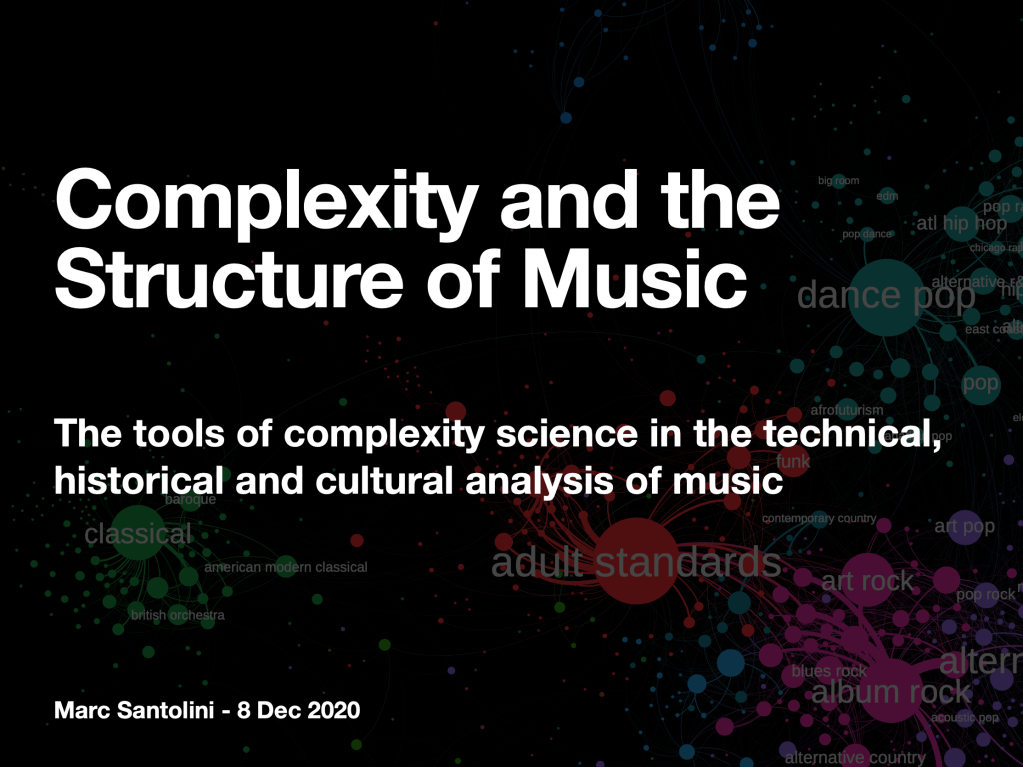
Measuring Music Complexity Across Cultures and Time

What makes music complex? And can we measure that complexity across cultures and time?

I had the pleasure of joining a panel at the Santa Fe Institute’s Complexity and the Structure of Music Working Group, where we explored how tools from complexity science—network theory, statistical mechanics, and cultural analysis—can help us better understand the structure and evolution of music. In my talk, I shared perspectives on how music can be studied as an emergent, self-organizing system, bridging technical patterns with human perception.

You can find the event details here:
🎶 SFI Complexity and the Structure of Music Working Group

You can also watch the full panel here:

Visit and talk at the Santa Fe Institute

I have visited the Santa Fe Institute for Complex Systems from Wednesday 20 Feb to Friday 22 Feb. This was the occasion to discuss potential projects with future CRI fellow and “network archeologist” Stefani Crabtree, as well as discover this fantastic place in the desert mountains of New Mexico!

Continue reading

Prize for best presentation at Complex Networks 2017

My presentation on iGEM got the prize for best presentation at the Complex Networks 2017 conference in Lyon, France ! In this work, we investigate criteria of performance and success of teams in a scientific context. We leverage laboratory notebooks edited on wiki websites by student teams participating to the international Genetically Engineered Machines (iGEM) synthetic biology competition to uncover what features of team work best predict short term quality (medals, prizes) and long term impact (how the biological parts that teams engineer are re-used by other teams). Thanks to the organizers for the nice award (and I got two beautiful pens :))!