
Our paper on the mobility of scientists through the knowledge landscape has been accepted in EPJ Data Science! In this study, we build on our earlier work on the rise and fall of scientific fields in arXiv (see this post), and propose a new lens: what if we studied science like we study human movement?
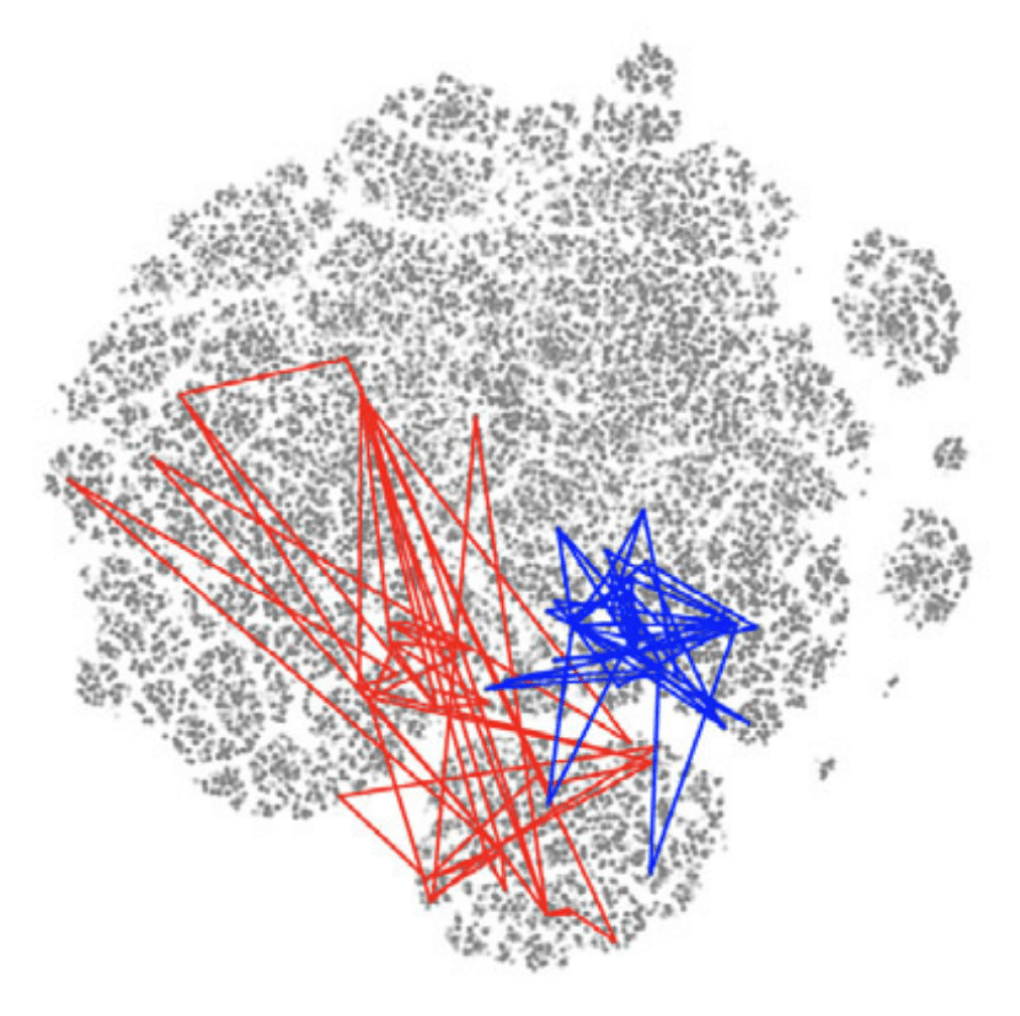
We constructed a low-dimensional map of scientific knowledge using t-SNE embeddings of 1.5 million arXiv preprints across physics, computer science, and mathematics. This space allows us to track researchers as they “move” through fields via their publications—each trajectory forming a unique scientific path through the landscape.
What we found is that scientific mobility mirrors human mobility. Researchers tend to jump between nearby areas, and long-distance jumps are rare. When aggregated, these trajectories form flows that follow a gravity model: dense regions attract more moves, while distance dampens them.
Digging deeper, we identify two distinct profiles: interdisciplinary explorers, who jump across fields and often contribute to disruptive, early-stage work; and exploiters, who stay within a core area, producing more incremental contributions.
This explorer–exploiter dichotomy not only reveals how individuals navigate science, but also suggests new ways to understand innovation, interdisciplinarity, and career dynamics. Importantly, our framework opens the door to assessing how external interventions—like funding or policy—could reshape these trajectories.
We’re excited about the implications of using mobility tools to study scientific evolution, and how this can help reframe debates around novelty, impact, and exploration.
Here is a thread summarising its findings:
 Marc Santolini