How do we design social containers that support the emergence of healthy, adaptive groups?
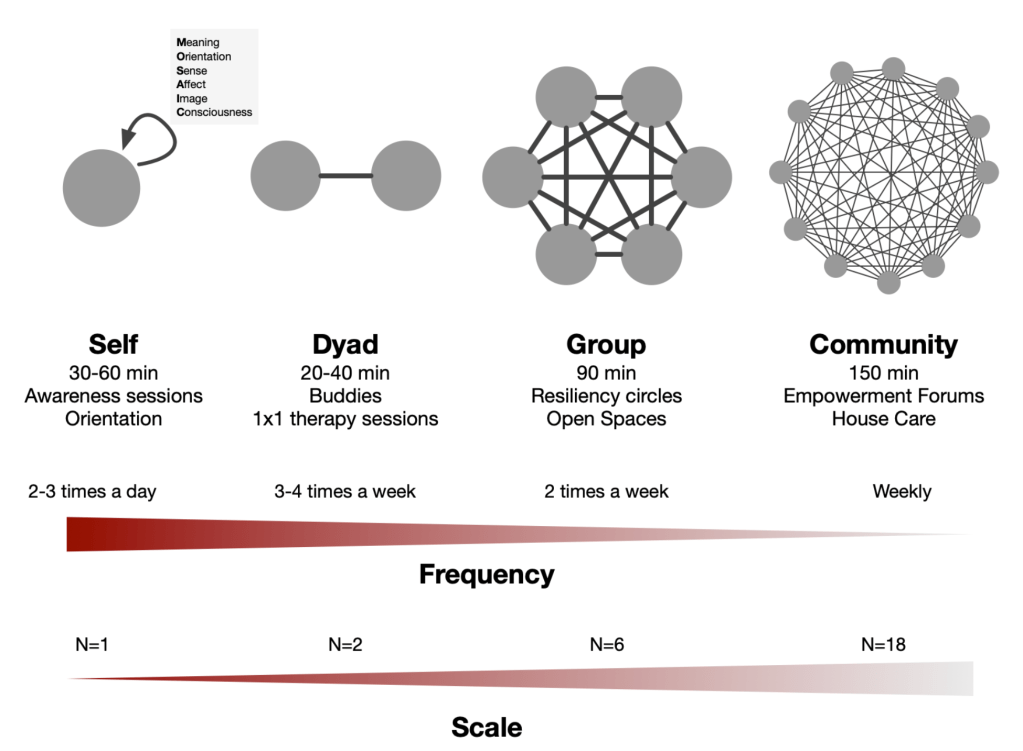
In our forthcoming article in Group, we propose a multi-level developmental framework rooted in complexity and network science. We explore how structured environments—composed of nested scales of interaction (self, dyad, group, community)—can cultivate core relational competencies such as co-regulation, perspective-taking, and group-level coordination. These capacities are not merely psychological traits but emergent properties of well-designed interaction networks.
We present the “Relational Embodiment” residency as a case study: a two-week experimental setting designed to foster attunement across scales. From morning meditation to facilitated group sessions and community co-care, each layer acts as a developmental scaffold. Our systems lens suggests that such containers—when well-designed—can become generative infrastructures for collective intelligence and transformation.
For those designing participatory environments—from learning communities to social labs—this framework provides practical guidance for cultivating the conditions under which healthy, adaptive group processes can emerge. It bridges theory and practice by showing how intentional design at multiple levels of interaction can foster the relational infrastructure needed for group flow, shared leadership, and long-term collaboration.
📖 Read the preprint: https://osf.io/preprints/psyarxiv/rtw2b_v1
 Marc Santolini
One thought on “From Self to System: Designing Social Containers for Collective Intelligence”