Team success isn’t just about outcomes—it’s also about how people feel, relate, and engage along the way. Understanding and improving this human dimension of participation is key to building teams that flourish. That’s the question we set out to answer in our latest study in the journal Computers and education: Artificial Intelligence, a collaboration between the Artificial Intelligence Research Institute in Spain and our team at the Learning Planet Institute in Paris. Together, we explored how artificial intelligence can help compose better teams in Challenge-Based Learning (CBL) environments, with a special focus on participants’ experiences—what we call participation quality.
We worked with the Goodwall platform and the YOMA initiative to engage 97 young people from 16 countries in a global online video challenge. We used an AI algorithm—Edu2Com—to form half of the teams based on a balance of skills, personality, and gender diversity. The other half were assembled randomly. After the challenge, we asked participants about their experience: how they felt working with their team, what skills they developed, and how the challenge affected their confidence and social connections.
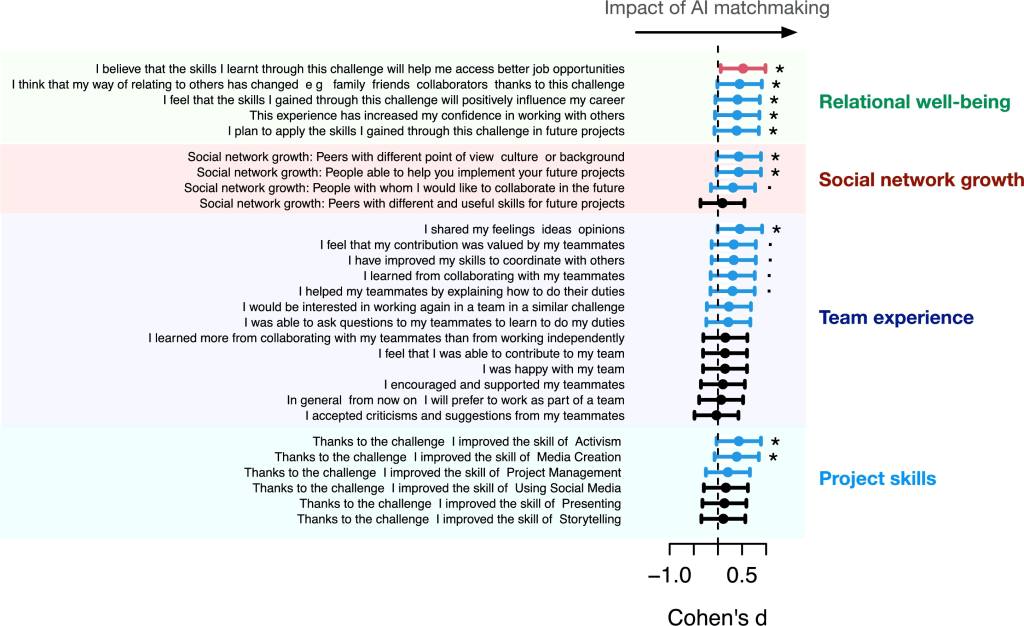
Teams formed by the AI reported significantly higher levels of relational well-being, including stronger social bonds, greater confidence, and a deeper sense of value in their contributions. These participants also saw growth in their social networks and improved skills in areas like activism and media creation. Interestingly, while the algorithm had a modest (non-significant) effect on final project quality, it had a much stronger impact on the human experience of teamwork.
We also investigated how to tune the algorithm depending on the goals. If you’re aiming to maximize project outcomes, focusing more on competency works better. But if your goal is to foster inclusive, meaningful participation, increasing diversity in personality and background has a greater payoff. There’s no single best setting—what matters is aligning the algorithm with your values and objectives.
We believe this study offers a new way to think about team design: not just as a way to boost performance, but as a tool to promote well-being, inclusion, and long-term motivation. AI can help us create teams that don’t just work—but thrive.
📖 Read the article: https://doi.org/10.1016/j.caeai.2025.100388
 Marc Santolini