
Integrating Behavior, Text, and Networks to Forecast Online Participation

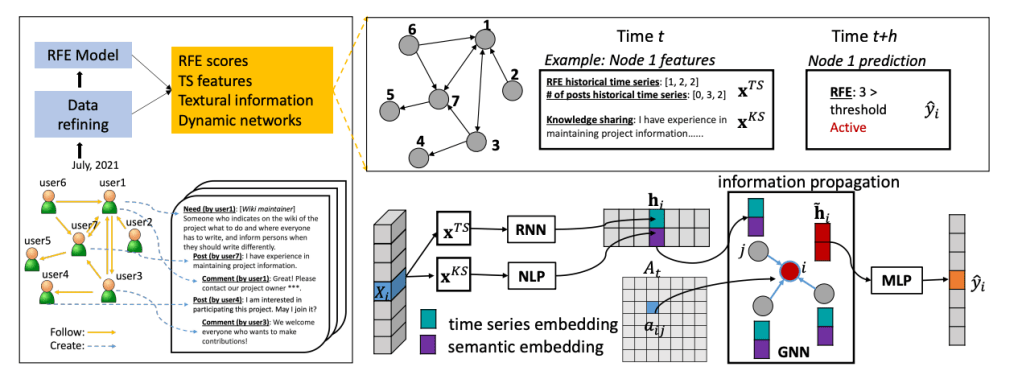
As online platforms increasingly rely on voluntary contributions—from open science to collaborative innovation—the ability to anticipate user engagement becomes both a scientific and practical priority. Yet predicting who will stay active, who will disengage, and why, remains a complex challenge. Our recent paper, KEGNN: Knowledge-Enhanced Graph Neural Networks for User Engagement Prediction (Fan et al., International Conference on Multimedia Retrieval 2025), introduces a novel framework that addresses this gap by integrating behavioral, social, and semantic signals into a unified predictive model.

Continue reading
Teams That Thrive: AI-Driven Collaboration for Youth Participation

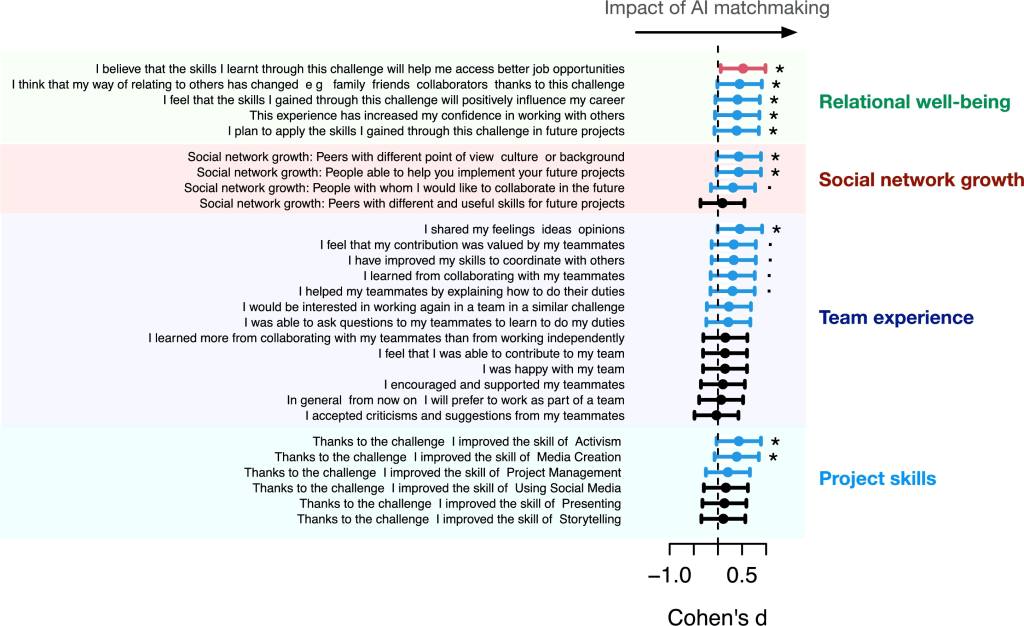
Team success isn’t just about outcomes—it’s also about how people feel, relate, and engage along the way. Understanding and improving this human dimension of participation is key to building teams that flourish. That’s the question we set out to answer in our latest study in the journal Computers and education: Artificial Intelligence, a collaboration between the Artificial Intelligence Research Institute in Spain and our team at the Learning Planet Institute in Paris. Together, we explored how artificial intelligence can help compose better teams in Challenge-Based Learning (CBL) environments, with a special focus on participants’ experiences—what we call participation quality.

Continue reading