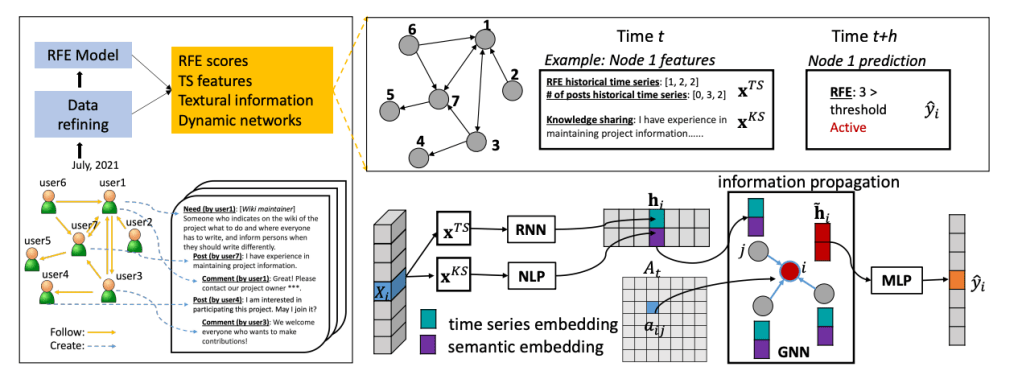
As online platforms increasingly rely on voluntary contributions—from open science to collaborative innovation—the ability to anticipate user engagement becomes both a scientific and practical priority. Yet predicting who will stay active, who will disengage, and why, remains a complex challenge. Our recent paper, KEGNN: Knowledge-Enhanced Graph Neural Networks for User Engagement Prediction (Fan et al., International Conference on Multimedia Retrieval 2025), introduces a novel framework that addresses this gap by integrating behavioral, social, and semantic signals into a unified predictive model.
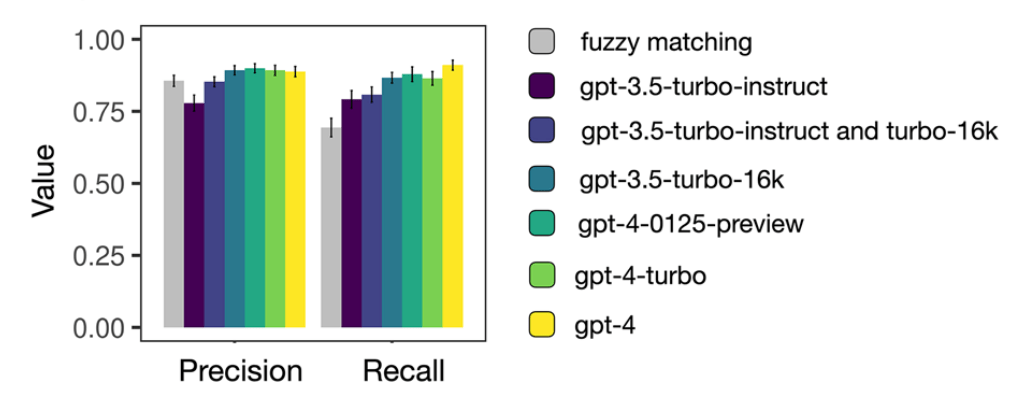
Understanding how scientists collaborate is key to improving research, but much of that collaboration is informal and buried in unstructured text. In our new article published in Applied Network Science, we show how Large Language Models (LLMs) can uncover these hidden networks—retrieving both inter-team collaborations and intra-team task allocations from free-form text with high accuracy.
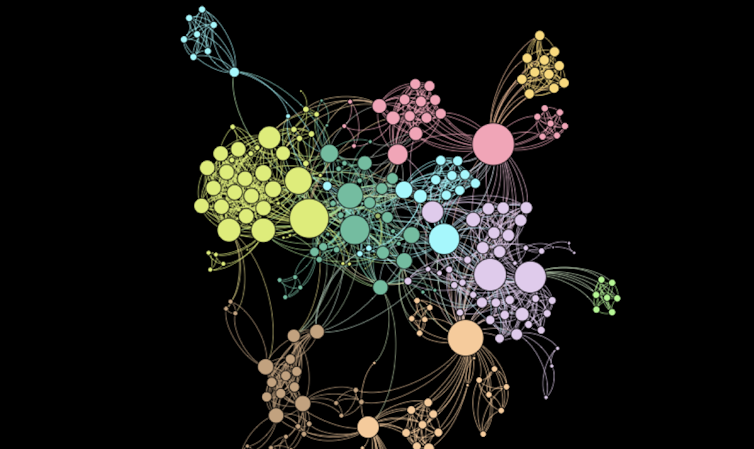
This new preprint is the result of a collaboration initiated during my postdoctoral stay at the Barabasi lab in Boston, which I continued at the LPI as an affiliated professor. In this project, we introduce the synthetic biology competition iGEM as a model system for the Science of Science and Innovation, enabling large-scale “laboratory ethnography.” We present the collection and analysis of laboratory notebooks data from 3,000 teams, which we deposited on the open archive Zenodo. We highlight the organizational characteristics (intra- and inter-team collaboration networks) of teams related to learning and success in the competition. In particular, we emphasize how teams overcome coordination costs as they grow in size, as well as the crystallization of the inter-team collaboration network over time, limiting access to relational capital for peripheral teams. This work is currently funded by an ANR JCJC grant to collect field data and build network models of collaborations and performance.
Our paper on measuring collaborations and performance in citizen science projects is out in Citizen Science, Theory and Practice!
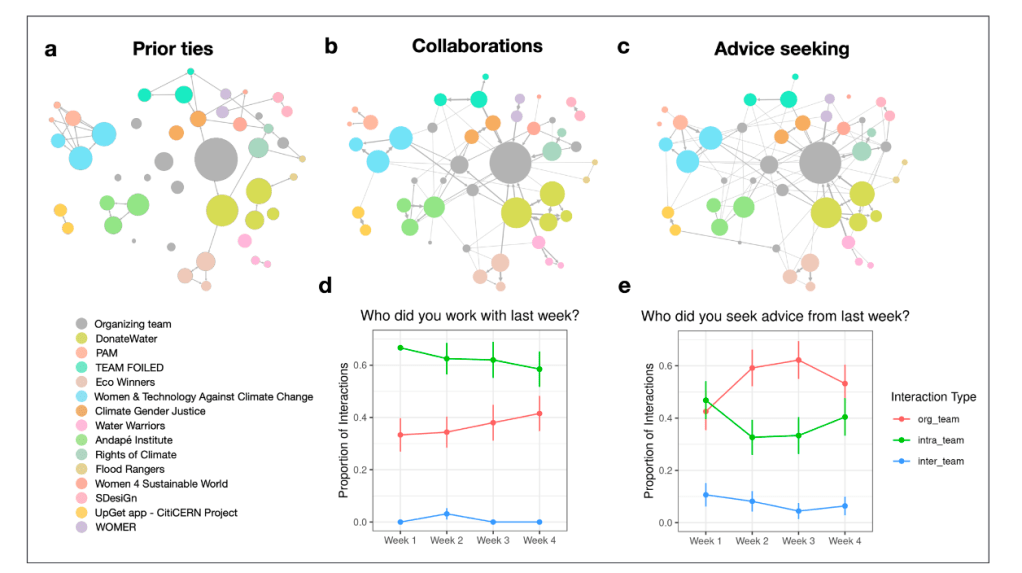
This work is the result of the European project Crowd4SDG, where we directed the part on the quality criteria of citizen science. We implemented the measurement of processual criteria based on a perspectivist and deliberative epistemology of citizen science published in the Royal Society Open Science (see this other post). With the help of the CoSo app (that we presented in this post), we monitored interactions within a collaborative ecosystem of citizen science innovation projects, revealing the relational dynamics and their influence on project performance. Our approach, combining digital analyses and self-reports, allowed us to break down interactions into multi-layer social networks, highlighting the importance of social capital and relationship management for the success of initiatives. We identified links between team structures, their communications, and the quality of their projects, emphasizing the impact of engagement and collaboration on producing relevant and innovative outcomes. This approach enriches the evaluation tools in citizen science and offers concrete ways to improve engagement, inclusion, and diversity in these projects.
How can we better understand how people learn, collaborate, and innovate together?
In this talk at the ACROSS Lab seminar in Hanoi, I presented how network science approaches can be used to study collaborative learning and problem-solving. Drawing from projects ranging from synthetic biology competitions to citizen science initiatives, I discussed how analyzing interaction patterns and participation dynamics can reveal key factors driving team performance, learning diffusion, and community resilience.
Can a global crisis awaken new forms of collective intelligence?
In the early days of the Covid-19 pandemic, I wrote an article for The Conversation reflecting on the unprecedented surge of collaborative research and open innovation initiatives emerging worldwide. In particular, I shared the experience of building the OpenCovid19 Initiative on the JOGL platform, where thousands of contributors—from data scientists to high school students—came together to co-develop open-source solutions, from diagnostics to ventilator designs.
This piece explores how digital platforms and participatory methodologies can support large-scale, decentralized collaboration—and asks whether this surge of collective intelligence can be sustained beyond the crisis.
My presentation on iGEM got the prize for best presentation at the Complex Networks 2017 conference in Lyon, France ! In this work, we investigate criteria of performance and success of teams in a scientific context. We leverage laboratory notebooks edited on wiki websites by student teams participating to the international Genetically Engineered Machines (iGEM) synthetic biology competition to uncover what features of team work best predict short term quality (medals, prizes) and long term impact (how the biological parts that teams engineer are re-used by other teams). Thanks to the organizers for the nice award (and I got two beautiful pens :))!

 Marc Santolini