The Geography of Knowledge: Tracking Researcher Mobility Through Scientific Space

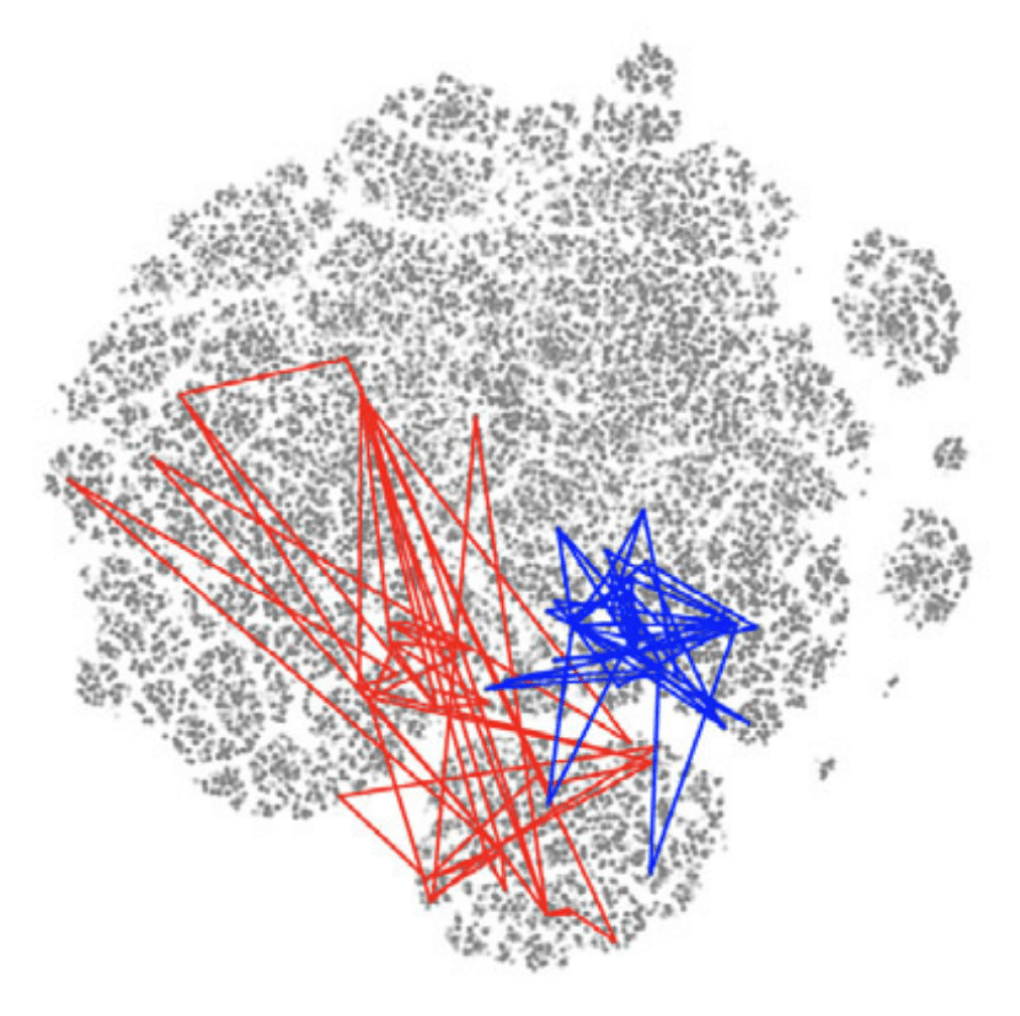
Our paper on the mobility of scientists through the knowledge landscape has been accepted in EPJ Data Science! In this study, we build on our earlier work on the rise and fall of scientific fields in arXiv (see this post), and propose a new lens: what if we studied science like we study human movement?

We constructed a low-dimensional map of scientific knowledge using t-SNE embeddings of 1.5 million arXiv preprints across physics, computer science, and mathematics. This space allows us to track researchers as they “move” through fields via their publications—each trajectory forming a unique scientific path through the landscape.

Continue reading
A Laboratory Ethnography at Scale: Lessons from 3,000 Synthetic Biology Teams

This new preprint is the result of a collaboration initiated during my postdoctoral stay at the Barabasi lab in Boston, which I continued at the LPI as an affiliated professor. In this project, we introduce the synthetic biology competition iGEM as a model system for the Science of Science and Innovation, enabling large-scale “laboratory ethnography.” We present the collection and analysis of laboratory notebooks data from 3,000 teams, which we deposited on the open archive Zenodo. We highlight the organizational characteristics (intra- and inter-team collaboration networks) of teams related to learning and success in the competition. In particular, we emphasize how teams overcome coordination costs as they grow in size, as well as the crystallization of the inter-team collaboration network over time, limiting access to relational capital for peripheral teams. This work is currently funded by an ANR JCJC grant to collect field data and build network models of collaborations and performance.

Continue reading

Quantifying the rise and fall of research fields

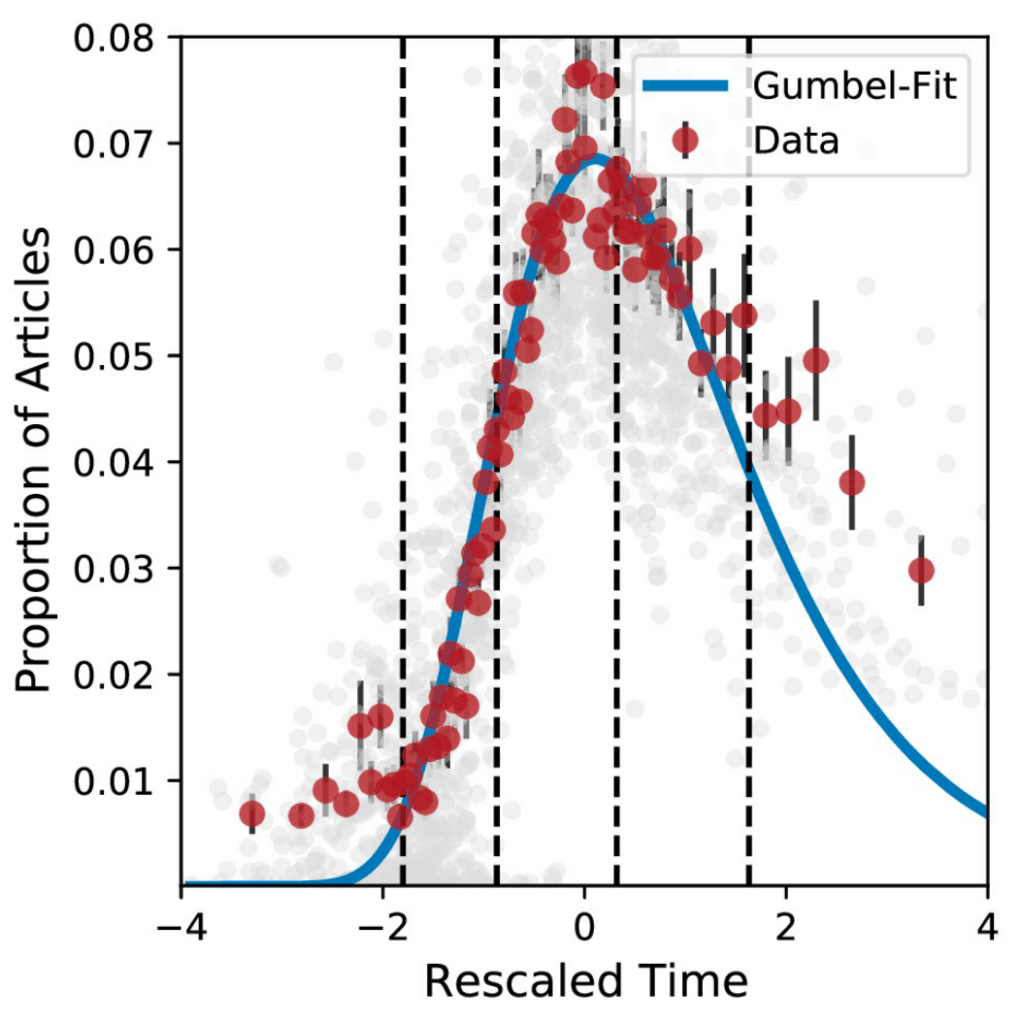
In this paper published in PLoS ONE, we leverage field tags metadata from the open access arXiv repository (1.5M articles) to reconstruct the evolution of 175 research fields from Physics, Maths, CS. We show that the observed rise and fall behaviour of fields is well described by a 2-parameters right-tailed Gumbel distribution, allowing us to rescale fields on a universal time scale and compare them on the same terms. Using delineations from the innovation literature, we then distinguish standard evolutionary stages of creation, adoption, peak, early and late decay, and we quantify characteristics of authors and articles at each stage. We find that early stages are characterised by small interdisciplinary teams of early career researchers publishing disruptive work, while late phases exhibit the role of specialised, large teams building on the previous works in the field.

Continue reading

Exploring Knowledge: Research Trajectories in Science

How do scientists explore the vast and ever-growing landscape of knowledge? Can we measure how new ideas emerge and spread?

In this talk, I presented our ongoing research on quantifying the exploration of the knowledge space, combining methods from network science, spatial mobility, and learning theory. Drawing on a unique dataset of 1.5 million open-access preprints from arXiv across Physics, Computer Science, Biology, and more, we traced the “research trajectories” of scientists as they navigate, explore, and exploit ideas over time.

Our findings reveal patterns in how researchers move through the knowledge space—sometimes as explorers, venturing into new territories, and sometimes as exploiters, deepening existing fields. This ecological perspective on knowledge foraging offers fresh insights into the evolution of science and innovation, with potential applications for research policy and collective learning.

📄 You can read the related article.

Visit and talk at the Santa Fe Institute

I have visited the Santa Fe Institute for Complex Systems from Wednesday 20 Feb to Friday 22 Feb. This was the occasion to discuss potential projects with future CRI fellow and “network archeologist” Stefani Crabtree, as well as discover this fantastic place in the desert mountains of New Mexico!

Continue reading