From Self to System: Designing Social Containers for Collective Intelligence

How do we design social containers that support the emergence of healthy, adaptive groups?

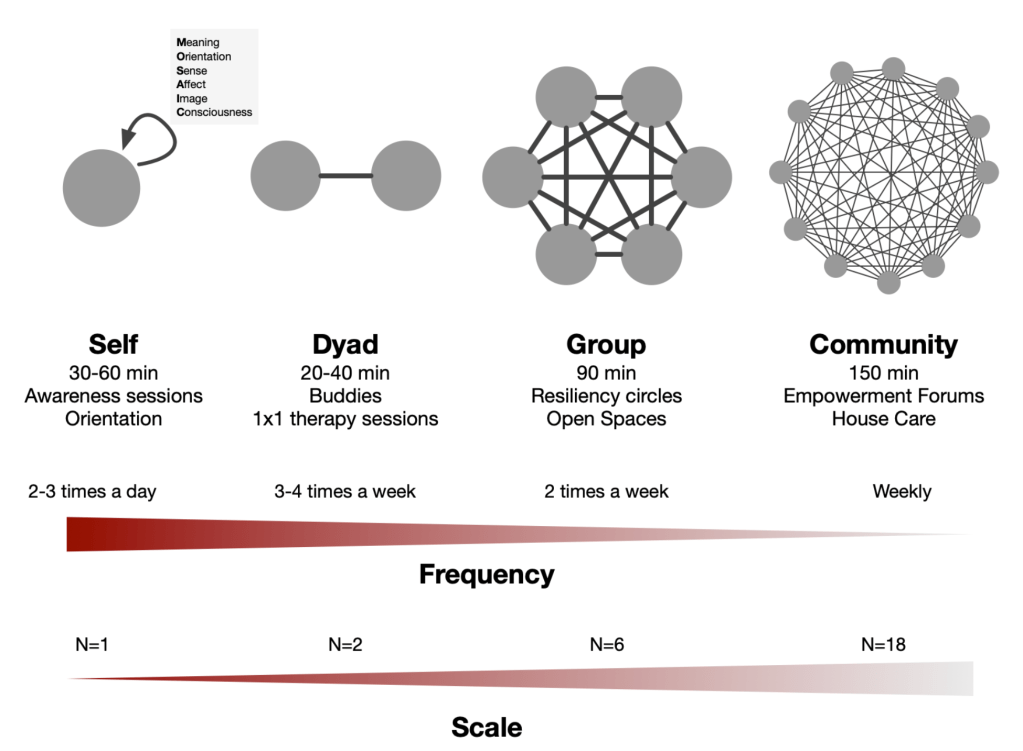
In our forthcoming article in Group, we propose a multi-level developmental framework rooted in complexity and network science. We explore how structured environments—composed of nested scales of interaction (self, dyad, group, community)—can cultivate core relational competencies such as co-regulation, perspective-taking, and group-level coordination. These capacities are not merely psychological traits but emergent properties of well-designed interaction networks.

Continue reading
A Laboratory Ethnography at Scale: Lessons from 3,000 Synthetic Biology Teams

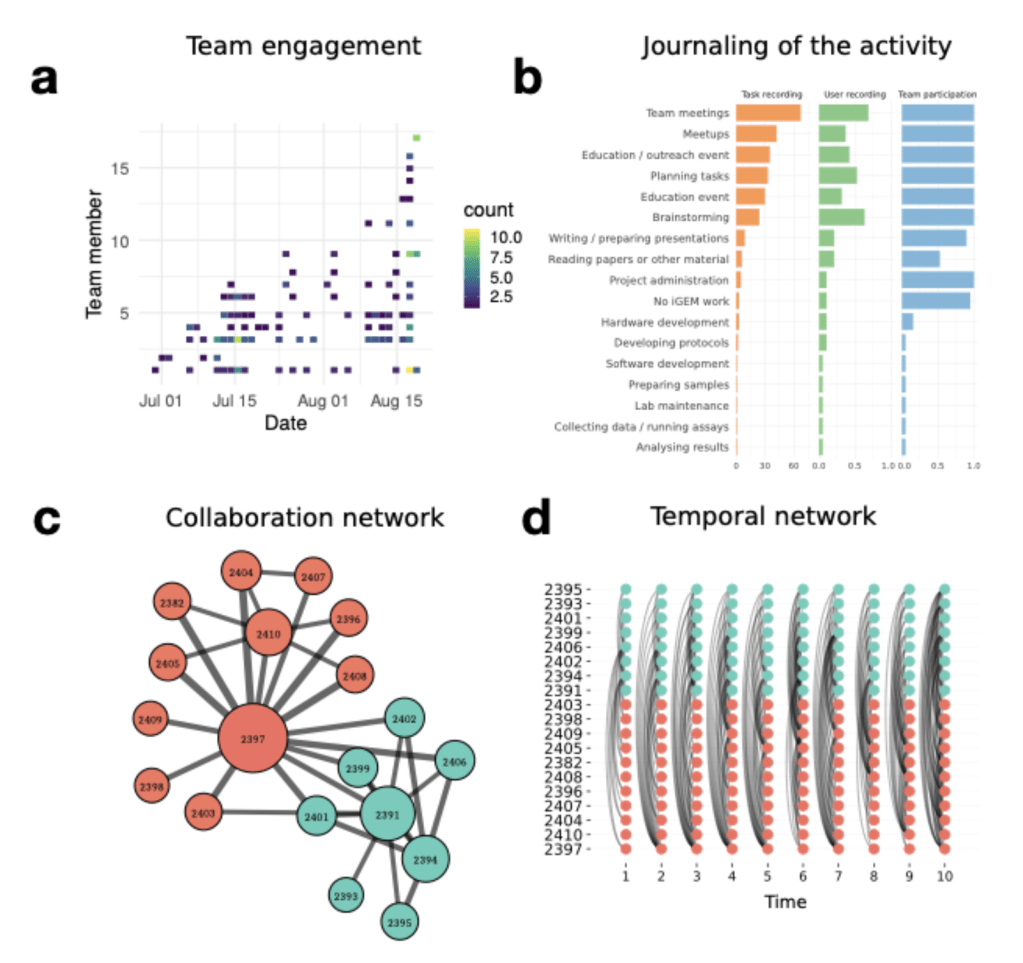
This new preprint is the result of a collaboration initiated during my postdoctoral stay at the Barabasi lab in Boston, which I continued at the LPI as an affiliated professor. In this project, we introduce the synthetic biology competition iGEM as a model system for the Science of Science and Innovation, enabling large-scale “laboratory ethnography.” We present the collection and analysis of laboratory notebooks data from 3,000 teams, which we deposited on the open archive Zenodo. We highlight the organizational characteristics (intra- and inter-team collaboration networks) of teams related to learning and success in the competition. In particular, we emphasize how teams overcome coordination costs as they grow in size, as well as the crystallization of the inter-team collaboration network over time, limiting access to relational capital for peripheral teams. This work is currently funded by an ANR JCJC grant to collect field data and build network models of collaborations and performance.

Continue reading

A “Collaborative sonar” to reconstruct team networks

In this new article presented at the ACM Conference on Pervasive and Ubiquitous Computing, we introduce the CoSo app (Collaborative Sonar) for large-scale collection of collaboration data within team ecosystems. The acquisition of passive social data through digital traces can be limited and often needs to be supplemented by qualitative approaches such as surveys or self-reported data. However, collecting relational surveys at scale poses challenges both in terms of human deployment and technical issues, as it involves probing the interactions relevant to an individual (for example, their team members). To address this need, we developed the CoSo (Collaborative Sonar) platform.

Continue reading

Prize for best presentation at Complex Networks 2017

My presentation on iGEM got the prize for best presentation at the Complex Networks 2017 conference in Lyon, France ! In this work, we investigate criteria of performance and success of teams in a scientific context. We leverage laboratory notebooks edited on wiki websites by student teams participating to the international Genetically Engineered Machines (iGEM) synthetic biology competition to uncover what features of team work best predict short term quality (medals, prizes) and long term impact (how the biological parts that teams engineer are re-used by other teams). Thanks to the organizers for the nice award (and I got two beautiful pens :))!