
Over the past weeks, I found myself moving between two different — yet deeply connected — spaces in the UK.
At the University of Cambridge, I gave a talk at the THRiVE research group on participatory and embodied approaches to learning. A few days later, I joined the Bloombox gathering, a small retreat bringing together educators, researchers, and theologians to explore care, conscious endings, and the deeper purposes of education.
One space was structured around research, methods, and conceptual clarity. The other unfolded through dialogue, presence, and shared inquiry. And yet, beneath these differences, both seemed to circle the same question:
How do we learn — and design systems — not only to solve problems, but to remain together in the face of difference, uncertainty, and conflict?
Making relational learning observable
At Cambridge, I spoke about what we have been calling pedagogies of togetherness: learning designs that place relational awareness, embodiment, and collective sense-making at the core of education.
The intuition behind this work is relatively simple. Many of the capacities we increasingly rely on — the ability to collaborate across differences, to navigate uncertainty, to stay present with tension rather than avoid it — are not purely cognitive. They unfold through attention, emotion, and the body. They are relational capacities, developed in interaction, often in subtle and hard-to-articulate ways.
Yet these dimensions remain largely invisible in how we study learning.
A central challenge, then, is methodological: how do we make these processes observable without flattening them? How do we study emotional and relational dynamics in ways that remain faithful to their complexity?
Our approach has been to combine several layers of observation. Participants document their experience over time through journaling and restitution, allowing us to trace how emotional and relational trajectories unfold — often revealing arcs that move through tension, blockage, and eventual integration. These narratives are complemented by more structured forms of coding, including attention to somatic experience — how shifts in the body relate to shifts in perception, interaction, and meaning-making. Importantly, this process of documentation is not external to the learning itself. It becomes part of the pedagogy: a way of cultivating awareness, both individual and collective.
Underlying this work is a broader hypothesis: that developing the capacity to sense and feel what we might call the “social body” — the relational field of a group — enables more adaptive and caring forms of collective action, particularly in contexts where coordination, disagreement, and uncertainty are unavoidable.
👉 Slides from the talk
Inhabiting care and endings
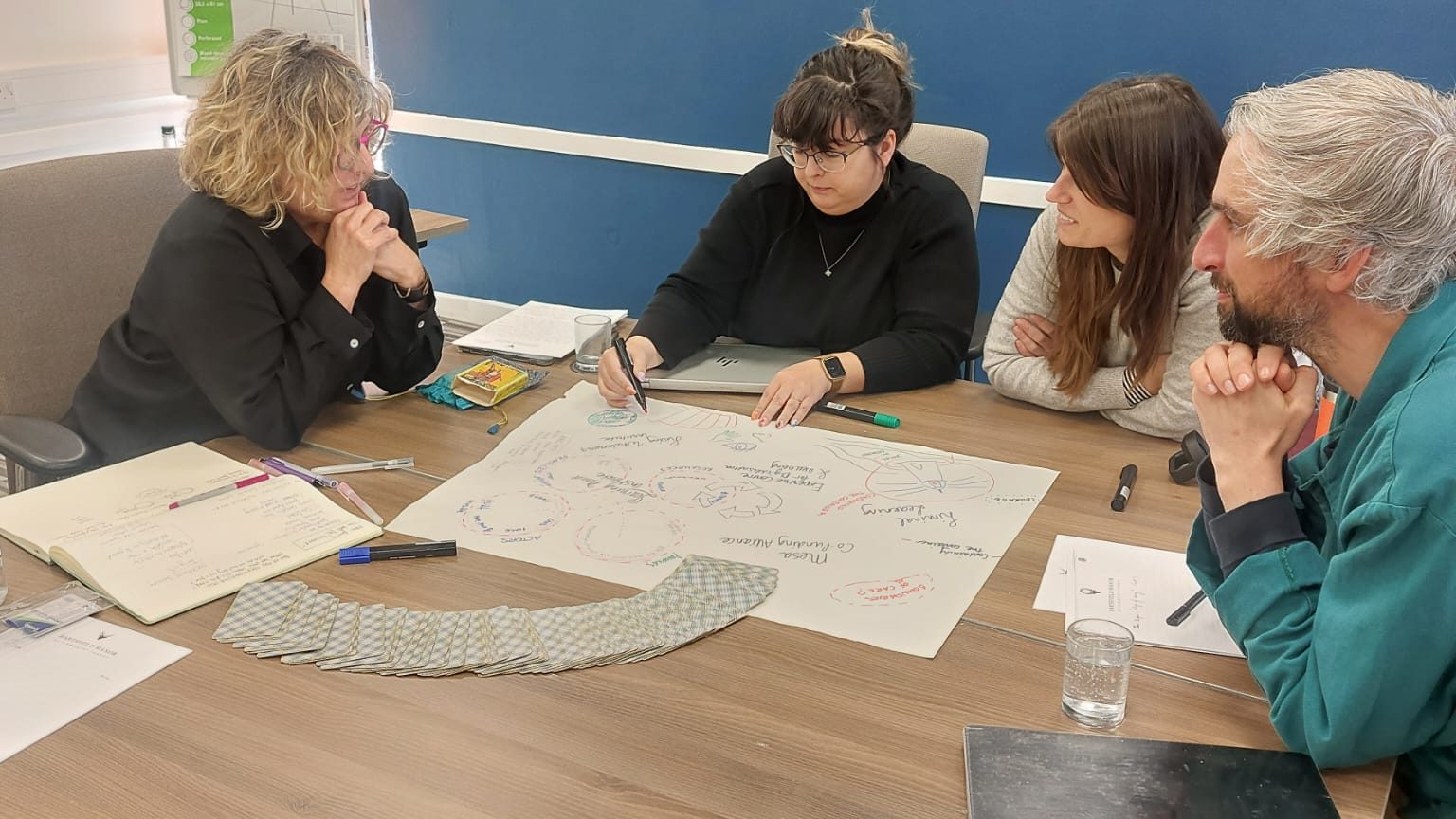
At the Bloombox gathering, these questions were taken further — not only as objects of study, but as lived concerns.
Bloombox itself is an interesting object. Developed by the GEMH Lab, it is a toolkit designed to bring together science and design in the creation of interventions for human flourishing. It proposes a structured yet flexible process — from a one-page project canvas to tools such as “values tension” mapping or “Alt-CV” conversations — while grounding design choices in developmental science, clinical psychology, and systems thinking. At its core is an attempt to bridge rigor and creativity: to make space for play, iteration, and curiosity, while remaining evidence-based.
The gathering brought together people working at the intersection of education, research, and spiritual care. Rather than asking how to observe relational dynamics, we were invited to inhabit them — to reflect on what it means for a system to care, and what it means to accompany not only growth, but also endings.
One recurring insight was that care is not a secondary layer in systems — something to be added once the “real work” is done. It is infrastructural. It shapes how attention circulates, how conflict is held, how people are included or excluded, and ultimately how a system evolves.
Another theme that stood out was the question of endings. In education and in organizations, we devote significant effort to designing beginnings and processes, but very little to how things conclude. And yet endings are formative moments. They shape how experiences are integrated, how meaning is constructed, and whether transitions open or close possibilities.
A phrase that stayed with me was that of “chaplaining systems.” In healthcare, chaplains are sometimes described as “technicians of presence” — people who accompany others through moments of vulnerability, uncertainty, and transition. Extending this idea to collective contexts raises an intriguing question: what would it mean for educational systems, organizations, or communities to develop capacities for presence at that level? What practices would allow groups not only to function, but to attend to their own emotional and existential dynamics?
From structure to sensing
Moving between these two spaces also made something else more visible in my own trajectory.
Much of my earlier work — shaped by complex systems and network science — focused on structure: interaction patterns, measurable dynamics, formal models of coordination. This perspective remains essential. But I find myself increasingly drawn to a more “flesh-centric” (extitutional) understanding of systems — one that foregrounds sensing, awareness, and lived experience.
From this perspective, systems are not only networks of interactions. They are also fields of attention. Their capacity to adapt depends not only on their structure, but on their ability to perceive themselves — to register tensions, to integrate differences, to respond in a way that is not purely reactive.
Breakdowns, then, are not only structural failures. They are also failures of sensing and integration.
This is where practices such as social somatics, dialogical inquiry, and social arts become relevant — not as peripheral or “soft” additions, but as core mechanisms through which systems develop forms of self-awareness.
Bringing the threads together
What these two moments made clearer is how these strands of work can inform each other.
On one side, we are developing ways to study relational and embodied processes with increasing rigor. On the other, there is a growing body of practice that engages directly with care, presence, and the lived experience of collective processes.
Bringing these together suggests a slightly different orientation for education.
Not only as a space for acquiring knowledge or solving predefined problems, but as a space for developing the capacities needed to participate in collective life — to sense what is happening in a group, to navigate tension, to stay in relationship, and to contribute to shared meaning-making.
These capacities are not peripheral. They sit at the core of how groups, communities, and societies engage with difference, respond to uncertainty, and sustain forms of cooperation over time.
In that sense, the question becomes less about what individuals know, and more about how they are able to be — with themselves, with others, and within the systems they are part of.
 Marc Santolini