A conversation with Jule Timm, whose thesis explores resonance in art and permaculture.
I remember that we talked in November, and you were telling me about music. I don’t really remember the example you gave me, but I remember you said something about a project where you had different people in a darkened room, and they were singing together. And that somehow stuck with me in connection with resonance.
Sure. So a few years back I developed a resonance singing practice — though many other people are doing that already. Resonance singing exists under other names: spontaneous chant is another frame for it, and there are similar practices with circle songs, but it’s slightly different. Resonance singing is a practice I’ve developed within communities in France where we would explore the use of art practices in relation to collective developmental practices — how the self can develop in the context of collectives, and what rituals collectives can use to experience a sense of unity, or polarity, or things like that. You’re familiar with social arts as being such practices.
In resonance singing, the practice is very simple. I usually do it in relatively dark rooms, lit only with candles, so that there is a safety in being vulnerable — because many people are not comfortable with their voice. You want to welcome them. It’s not about singing. It’s about, I would say, vocal release.
The main practice is a practice of emergence. You’re in a circle, and the idea is that the group is like a bowl — at some point the bowl will be struck, and there will be a sound starting. Someone can start because they feel already in resonance with the space. The space is inhabited by an intention, you feel that, and somewhat it goes somewhere. The most important part of the practice is that because the group is a bowl, you have solidarity with your surroundings. As a bowl, you’re vibrating with your surroundings. When you hear something around you, you start to join it. And when you join, you try to merge into that sound. There’s a moment where your voice will start to fade into the sound, and it’s like this whole sound is coming from you and not from you at the same time.
That lasts during one breath. But then you have to catch your breath, and at that moment there’s a silence from your side. That’s the moment where you come back to your body, to your attention and your intention. Are you coming back with the same voice, listening to the same story? Are you coming back with something increasing, or decreasing? That’s a moment where you are in between. And you do that for maybe around ten minutes until usually it fades by itself, because a story has been told.
That’s the simplest basic element. But that element builds up the resonance capacity of the group — listening capacity, appreciation of silence, and appreciation of the support of others. In particular the support of small voices: sometimes you come back and there’s a small voice, and you can support it because you want to merge with that little resonance in the bowl at that time. As we run sessions, we begin to add layers of more autonomy, usually starting with introducing movement in the space, where you begin to explore dyads, triads — it’s like a village, a Social Presencing Theater practice, but in sound. With Agathe [from the Learning Planet Institute, Paris] we’ve actually started making a workshop of resonance singing that involves somatic movement practice at the same time, to explore the intersection of both.
One could call that fieldwork of experimenting with communities, collective intelligence, and social arts. It’s only recently that we’re starting to use it as a proper research locus. For now it’s been more participant observation, and the research has been at the scale of doing it, practicing it, and experimenting with variations. With Agathe, we started asking for feedback from the people to see what is working for them. It’s not something we’ve yet written about. I wanted to write something for the Aalto art research conference at the end of last year but the timeline was too short. This year we are thinking of writing something about it.
It sounds very interesting — how participants go into the space maybe not as confident, because I feel there is often shame connected to voice, or insecurity, and then this feeling of being part of a group, and then going out having had that connection and having been heard.
That’s absolutely correct. In some groups there have been people who had a really fragile relation to voice and were preferring to be listeners rather than producers. With some of them, we worked on dyads. In dyads you can do a resonance practice that’s like non-verbal therapy in a way — you support a person in feeling their voice and in entangling their voice with a voice that holds them. It’s a way to lock in with the person and to open through voice by supporting the opening through the resonance field. You’re creating a space where both are entangled, and then you’re supporting an opening. It’s like osteopathy, but with sound.
We’ve been experimenting with having the person in the middle of the circle, proposing their voice and turning around to get supported by the people who listen. It creates a scaffold for supporting a form of leadership through that. And the resonance concept is really about finding where the resonance frequency of the person is, and helping lock in to that.
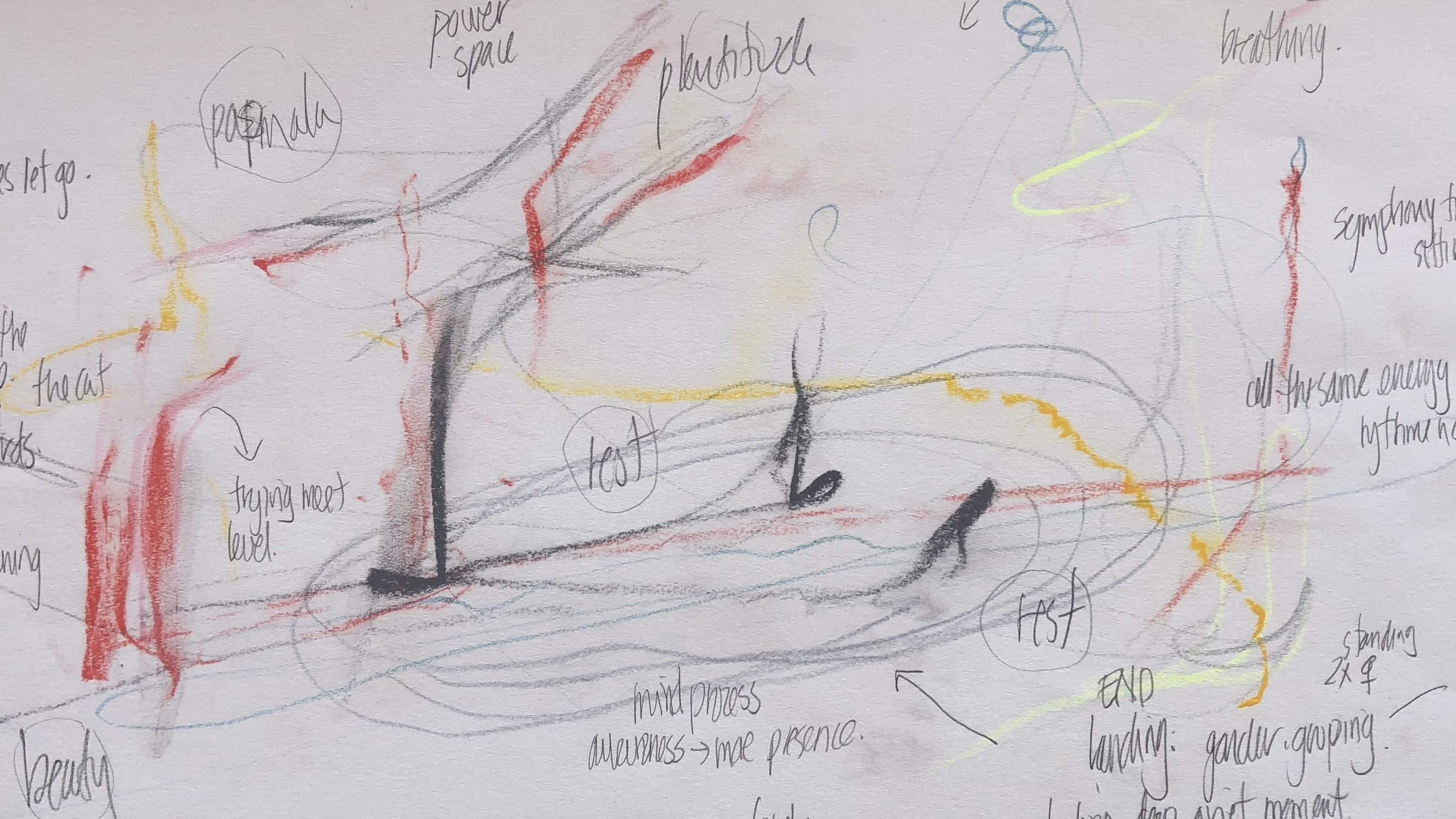
From the resonance singing part, we’ve also experimented with more multimodal approaches that involve music, spoken word, dance — modalities to resonate in textures. Everyone has a way to enter these spaces that might not be with voice but with another medium — even the texture of their intentions, their body can be a way to express a certain frequency. Today, just before this call, we had a resonance session with Agathe, Annina, and Julienne [from the Pedagogies of Togetherness consortium]. Each of us had a modality: I had sound, Agathe had movement, Annina had poetry, and Julienne had a canvas to draw on. We would do a resonance with each person doing something, then there’s a space of breath, then another person’s space, and we’re presencing into the build-up of that.
So one person was not performing but kind of presenting something while the other ones were listening?
Yes, exactly. But it’s like deep listening as the other person is doing it — you’re doing a deep listening, and then doing your resonance. In the resonance singing, everyone is doing it at the same time, but that’s a particular thing about singing compared to any other practice: you have to stop, because it’s part of the breath work. So no single person can hold power. You have a renewal of leadership. It’s like a deep democracy in a way — you cannot hold power for so long.
Deep democracy — I like that. Were you answering or observing in the practice you had today?
You’re listening to what’s happening, then you let it settle — what they call ma in Japan. And from that space, you go back to the present, feeling what’s alive in the present moment. You still have a trace of what happened, it builds a certain energy in your system, and whatever is now in your field — in that silence — then you act. So it’s not a response; it’s a presencing that incorporates that trace.
Are you mainly working with resonance in relation to music, or also with relational practices more broadly? I also looked at your website, and the relational practices probably go a lot with the resonance.
I started this work through relational mindfulness practices — awareness-based design applied to the relational quality of a group. I started with more verbal practices where people verbalize resonance with what has just been shared. Someone shares that in the present moment something emotional is taking place, it brings a memory, that’s how they feel about it — and then another shares a resonance of how they feel about that. It builds up a recursive deepening of what’s happening until you get into fragile places. That’s when it gets heated, it touches a cord.
So I started with these more verbal practices that work with images, meaning, the somatic, the embodied — people talking about what’s happening in their body. We call that social somatics. And only over the past year have I started to take seriously the idea of also using art-based, non-verbal practices as a locus for implementing and studying relational mindfulness. With Zoe and Louise [students at the Learning Planet Institute], who were part of the early Pedagogies of Togetherness residency — they did a research project where every day one person would do a movement and send it to the other on WhatsApp, and the other would give a resonance with a word. Based on that, they built their collaboration by understanding where they were in their journey of the research project. And we’ve been studying the evolution of their body postures and of the words throughout time, to understand the impact it had on their research project.
For the resonance with sound specifically, right now it’s only been used in punctual workshops where we ask people what felt alive, what worked, what did it mean for them in terms of their leadership, and how does it inform what they bring back home. The people we’ve worked with so far have been more people in facilitation and coaching circles, who are already very primed to hold this kind of space. We’re intending to work more with students going forward.
What is resonance to you? I’ve been writing about it for the last months and I feel like you can just go with it forever, there’s so much to look into. But what do you think is the important thing?
My early background is physics. And in physics, resonance has a very particular definition — any material has what is called a resonance frequency. If I were to bring a certain sound at that frequency, that material would begin to agitate, potentially even break. You see that with wind at a certain speed: the bridge begins to hit a frequency. So resonance has something to do with a very specific property of a localized structure — it could be an organ, a cell, a body, a group. It’s fractal. Any level can have one.
So any bonded region has a resonance frequency that can be probed — through light, through sound, or through something much more imaginal, not necessarily physical like a sound wave. Maybe there’s a frequency to the way an emotion moves. If you send an emotion that has a quality of cold, it will hit at a frequency in someone that has a quality to receive cold. It could go to a specific location in the heart, have a crisp low temperature, maybe sharp. And at that moment there will have been a response — a reaction through that pattern. But you’re not defined by that. It’s just one way you can resonate.
And it’s also dynamic. By working on the heart, that resonance frequency can be lowered so that a wider spectrum can resonate — maybe to warmer things. Something that can be intentionally moved. I do see that as being around me in the room: people have resonance frequencies, many in them. There’s resonance frequencies of the environment, of the matter. They can be probed with sounds, emotions, colors — there’s resonance potential with things. And when there’s resonance, it becomes indistinguishable who is producing. Suddenly there’s a co-inhabiting of the parts at play.
It’s super interesting to have that physical background — to think about resonance as a material-level property, not just a social one.
Yes. And as I said, for me it’s really a dynamic property of what creates movement under a forcing. In physics you would call that a forcing: something is at rest, and now you’re forcing it with a frequency, and that thing moves. It’s very much a property of what creates co-movement, what connects individual movements.
Resonance is something you can’t control in a way. You can set the conditions in which resonant encounters are possible, but you can’t force it. There are many things that hinder resonance — stress, time, if it’s too busy or people don’t feel comfortable, they will likely close themselves off. I’m interested in artistic practices or art contexts: how can I create the setting or the conditions in which resonance is possible? Because I feel like it’s very rarely that something in a museum really touches me, where I feel moved or transformed. And I think art has such great potential to have an impact on society — to create connections between people, or to have you go out afterwards and feel a bit changed. That’s why I’m interested in researching resonance in art.
That’s beautiful. It reminds me of researchers working on awe — how to induce awe, which has a similar opening quality. And listening to you on resonance, it connects me to a tradition I’ve been engaging with: the Dharma art tradition, popularized by Chögyam Trungpa Rinpoche in the US with True Perception — a Tibetan body-based approach to art. These practices work a lot with the association of colors, sounds, places in the body, and elements: space, water, fire. I’ve noticed on myself that these practices are training resonance — they’re creating almost a Pavlovian reflex. Now when I see green, there is wind, there is the energy of this all-pervasive energy, and I can connect to spring, to cycles. Without that training, it would just be aesthetically nice. But with somatic training, there are resonances at the body level, the emotional level, the felt-sense of openness level. The idea is that resonance isn’t absent — it’s not happening because there is friction. Past experiences, maybe green is associated to something I’m afraid of, things I’m not opening to. If we remove that friction, we would enter resonance naturally — everything would become resonant. But resonance can also break things. It can break a bridge. So there’s work involved.
I believe art can infuse that if it’s accompanied with a capacity to read it. In Bhutan, when I visited two years ago, every piece of art around was infused with symbols related to practice. Every single piece is like going to a church and being able to read it through the body. Everything becomes: these colors are hope opening in the heart, this color is grounding in earth, that brings me back to something I’m born out of. Without the practice, we’re disconnected from the meaning of art.
Ann-Christin Taylor — in anthropology — has qualified this as a connection between myth, ritual, and iconogenesis. If they are disconnected, the myth becomes fiction, the ritual becomes folklore, and the iconogenesis becomes western art — disconnected from their sense-making strategy and from the ritual. I think social art has this quality of reconnecting to a common story, to an art that we can feel together.
That’s super interesting, because there’s so much that if we haven’t experienced it, we can’t really relate to. It’s interesting to have this very different perception of art — you have so many associations to symbols and colors. If I would go to Bhutan and look at the same picture as someone from Bhutan, we would probably feel something very differently.
Yes. And in the very basic sense, art becomes resonant if there’s a participatory approach to it. In the deepest context it would mean, for an artist to tell its audience: let’s enter together in the way I channel spaciousness when I do this piece. You appreciate the mastery because you also went through the channeling practice they experienced when producing it. It’s almost the sensory metadata of the art. Jacob Collier does something like that in the sound world — he brings whole stadiums into singing together, a participatory means to understand his harmonic universe. Bobby McFerrin does that too. These are what I’d call resonant artists in the sound world — participatory approaches to have people enter the auditory sense-making.
I once saw a video of Collier improvising and was just astonished by his ear, by being able to improvise, and by including all these people together and creating that moment. And if you’re there in person, the presence of it is different.
Yes. And here we’re getting to the aspect of facilitating resonance. He’s using a more top-down approach — using harmony as a way to experience resonance naturally. But I’ve been in spaces where dissonance can become resonant, because it’s part of exploring the texture of conflict. It can become playful to explore that as a space where you have resonance over dissonance. Which is not easily something you can do in a concert. But you can explore it with art — it’s relational, and there’s a quick feedback loop between the artist and the experiencer. That loop is happening in Western art too, but over a long period of time — the exhibition happens, people give feedback, then other artists create art based on their resonance with that. What I’m talking about tends to be over a very short period of time, where your art form is completely infused in that moment with other art forms. And anyone, even without an art practice, can participate — their presence becomes part of the art. Like theater of the oppressed: the audience is also an actor.
Also about the dissonance and the harmony — Rosa describes that resonance is never complete harmony. There kind of needs to be this dissonance, or at least one needs to have their own voice. There can’t be complete overlap, but maybe a bit of friction that you’re then open to and feel that some kind of shift is coming. If it’s already the same, there’s no potential to change.
Absolutely. There’s something exploratory in it. What I’ve noticed to be most creative — especially in multimodal contexts — is about finding a way to express what is resonating at that time. If there’s a dissonance or a trigger happening, what is the way to express that? It becomes really fruitful either in a structured resonance space where each person expresses their resonance — like what we did just before this call, in our circle of resonance — or in what would be called collective free improvisation in music.
In those unstructured contexts, I’ve faced cases where one person takes over the space, especially if there’s a piano. The person’s back is turned and they can’t experience the others, and there’s an isolation happening. It feels like almost an embodied representation of separation — for a short moment of time, a part of the social body has isolated and grown, and the soundscape of that outgrowth is now taking over, with its back turned to the potentiality of diversity. I find it interesting because it’s telling something about how we are on the planet also — sometimes isolating ourselves as a society, disconnected from nature.
Once in that context, I went to the person and said: can you play less loudly, give space to others? And it created a very strong confrontational trigger — the person was almost in trance, and being pulled out created not just a dissonance, but more stuckness. Very oppositional. Like policing.
So another time, when the same thing happened, I tried something different. I went to where the person was with my voice — locking in with where they were, being with them, then starting to go together somewhere. With my guitar, maybe my voice. So that the person would now have a slightly wider awareness. And we could start to have a journey together, until the journey brought us to a lower, quieter place, where together we could feel: oh, wait, listen to that — there’s this other person doing this little thing. And from there on, that person entered a supporter mode, supporting others and feeling: oh yes, that’s an amazing thing to do. It changed the role structure from stuckness — where you can’t access the field anymore — to appreciation, to a generative resonance. There’s something about discovering the beauty of being in resonance, that it can be more beautiful than being technically entrenched in your own story — but that story isn’t negated. You can bring it to the resonance level. And it seems to have a lot to do with seeing how it feels to be seen, and loving to do that for others.
It’s quite interesting that you met the person where they were — not “please take less room,” but you kind of met them where they were, and then journeyed from there.
Yes, exactly. And I’ve seen people do that with babies — the baby stops crying because they feel: oh, I actually wanted to be heard.
What do you think is the potential for resonance in artistic contexts? I feel it’s easier to have resonance come about in socially engaged art practices, where you have other people, more time, more spaciousness. And with music, there’s somehow more of a direct connection to resonance.
I think it’s really about relational design thinking. If you have a museum — what is the way a person in front of a painting can have a modality to resonate? I’ve seen places where they would put a zafu, a Japanese meditation cushion, in front of a work, so that you could resonate with your presence. I’ve seen a context where an opera singer would sing in front of you, as your personal audience, and it would make people cry because they would receive that offering and could emotionally engage. Or maybe there’s something you can draw, colors you can engage with, a movement you can do — something where you can involve your body or your presence to participate. I really see that in terms of creating a space.
And that space — museums now, people come like in a nightclub. Bumping into you, you’re tired. It’s the same issue really: nightclubs are supposed to be shamanic crucibles of transformation. But everything is wrong about it. The museum is the nightclub of art. You’re supposed to enter with presence, with reverence, and with resonance.
For example, in the art practices of Bali — at least as ethnographically documented in the fifties and sixties, when Bali was still much more untouched — in villages, the theater would be going to the trance of a person. A priest would get a person into a trance, and they would take on an animal spirit — a boar, or a horse — and the whole audience would laugh because it was also a kind of comedy. But they would come and hold the person when they came out of trance. It’s like a theater where you’re living something sacred, knowing that, somehow, you’re also that animal, that animal spirits are part of your village makeup. As an audience you’re part of the buildup of opening that space, and you’re part of physically ending the space. And together you use soundscape to close it. There’s a whole technology of presence to that. The cognitivist John Vervaeke talks about relevance realization, resonance realization and reverence realization as steps. There’s a space technology of how you craft a space that designs for relational participation with resonance. So it is possible — but it has to be in a much more ritualized space.
At the start, rituals mark the entering. At the end there is a restitution: the space was held, and there is a portal where, before ending, you integrate — what does this mean, what do you bring back into your real life, what symbols carry forward? It’s like a door you enter and a door you leave. The cinema still does that a bit. You use ritual food — popcorn, which you almost never eat at home. You go from daylight into obscurity, even if it’s during the day. There’s a ritualized component. It’s still kind of working.
I like that comparison — the nightclub of art. But yes, these ritualizing spaces, or rituals as in setting different conditions for you to enter a different state — I think that’s very important. Though it’s so much more difficult because I’m not a curator. I’m doing an artwork and I have a limited amount of influence over how it’s perceived.
It could be as simple as proposing a practice alongside the title and description of an artwork — a practice of how to engage with it. In the same way that books right now just have text, with no practice to enter the book. But in old times, books would have a whole set of drawings around every page — symbols, images. There was a literacy around those. You knew how to enter the text. In the same way: you have an art piece, and you propose: take a few breaths, connect to the space of your body. How is your chest entering those lines? And from that entering, looking at this — how does it inform how you relate to x or y? Instead of: I had this idea in my art and I’m so good at it — how do you notice how you enter it? I personally have very little art literacy when it comes to visual cues in a museum. I can find it nice, but I don’t know how to read it. I never had someone bring me into the practice of reading art — apart from the Tibetan practices, where I can read what I would call religious art, art made to vibrate with the body and with emotions. What would it mean for the artist to engage with a practice of resonance for the audience? I believe you can enter through breath, through emotions, and you can learn something about your worldview and about others through that, and guide them.
And I guess there’s always the aspect of presence that you can’t skip. Something as simple as: take a breath in, take a breath out, as you take the breath in focus on the energizing component, as you breathe out release into the totality of that color. It creates something. I was thinking something similar for video installations — maybe connecting to people around you, where the video itself would give an instruction like: find the person furthest from you and acknowledge them, connecting to yourself and to the space.
For that to become meaningful, the space needs to hold an energy that can be crafted with facilitation. If it’s just a video running without facilitation, it becomes a playful, fun thing. But for it to be transformative, the instructions need a tempo, a container. For a single painting and a single person, the breath can be that portal in, portal out — that would be maybe the minimal viable thing. But if you go into dyadic or collective territory where people begin to do things together — as long as nothing involves consent aspects like touching or asking each other difficult questions — instructions can work. Once you go into spaces where it can move into loaded emotions, you need someone who provides that safety and that container.
I see that this container is sometimes broken in performance art, where it plays with trauma and often serves as a kind of therapy for the person doing it — but doesn’t necessarily create a resonant space for everyone to hold and process. There can be something of an ego dimension: someone using their art practice to actually work through their whole relation to their past. But there can be a thoughtful way to do that with resonance — where you can actually do collective trauma work through a performance designed to bring people into a journey together, creating a story around that difficult load. But it requires thoughtfulness about how you create a space where people know what they enter and enter into practice with you. That’s ritual design. There’s a whole field around that: consent craft, entering together.
I think there’s a lot I need to go back to my notes and process. Thank you so much for taking the time and sharing all of your knowledge with me. That was very interesting.
It was so useful, because you allowed me to do so much sense-making of things I didn’t even know I was thinking about. And at some point, I would love the reverse — if you do a public presentation of your project, I would love to be in the audience. Or we create an occasion: invite people from Pedagogies of Togetherness, from the institute, some students — because it’s an important topic and you’ve done a lot of work bringing literature to it.
Thank you. That’s very encouraging. I’ll send you the transcript. Enjoy your garden — I’m a bit jealous.