As the New Year just passed, I thought I’d give a go at a general life update and some personal reflections.
TL;DR: it was a busy year.
Continue reading
As the New Year just passed, I thought I’d give a go at a general life update and some personal reflections.
TL;DR: it was a busy year.
Continue readingWhere do bright ideas come from? What conditions foster real creativity in science?
In this Le Monde feature, I contributed insights from our research at the Learning Planet Institute on how innovative ideas emerge within scientific teams. Our analysis of millions of open-access publications revealed a striking pattern: the most disruptive and creative studies often come not from large, established teams, but from small, multidisciplinary groups of young researchers. Creativity, it seems, flourishes when intellectual risk-taking, diversity, and collaboration are encouraged over rigid hierarchies.
You can read the full article here (in French)
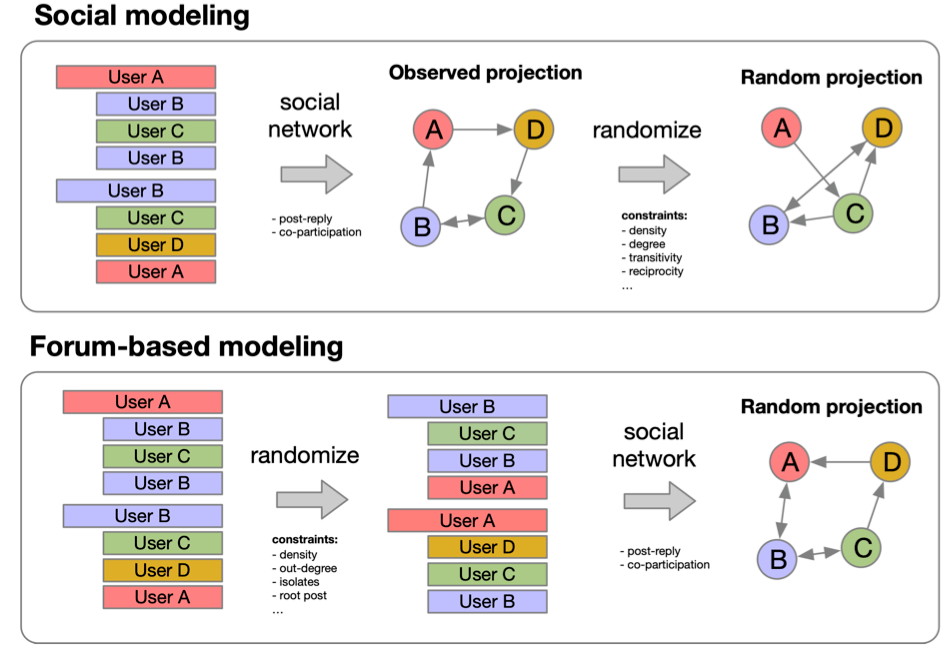
Together with Oleksandra Poquet and Liubov Tupikina, we asked a simple but often overlooked question: Are forum networks really social networks? In Learning Analytics, it’s common to analyze forum interactions as if they reflected genuine social ties. But how much of the observed structure is simply driven by posting behavior — who posts, how much, and when — rather than social dynamics?
In our paper, we introduced a null model approach, leveraging methods from network science to statistically test whether forum network patterns exceed what would be expected from posting activity alone. Analyzing data from 20 online courses, we showed that key metrics often used to infer social learning — such as degree or frequency of interaction — are largely artefacts of individual posting behavior. However, other network features, such as clustering, cannot be explained by posting activity and may better capture emergent social dynamics.
This work calls for more methodological rigor in how we interpret digital traces of learning interactions — and invites researchers to question when and how learning networks can be considered genuinely “social.”
📌 Read the paper
Published at LAK 2020
With Just One Giant Lab we just organized our first hackathon on Open Data and Vaccination for our first program Co-Immune! We had 6 teams with great ideas and projects using data science to better understand vaccination hesitancy and access to vaccines. More below:
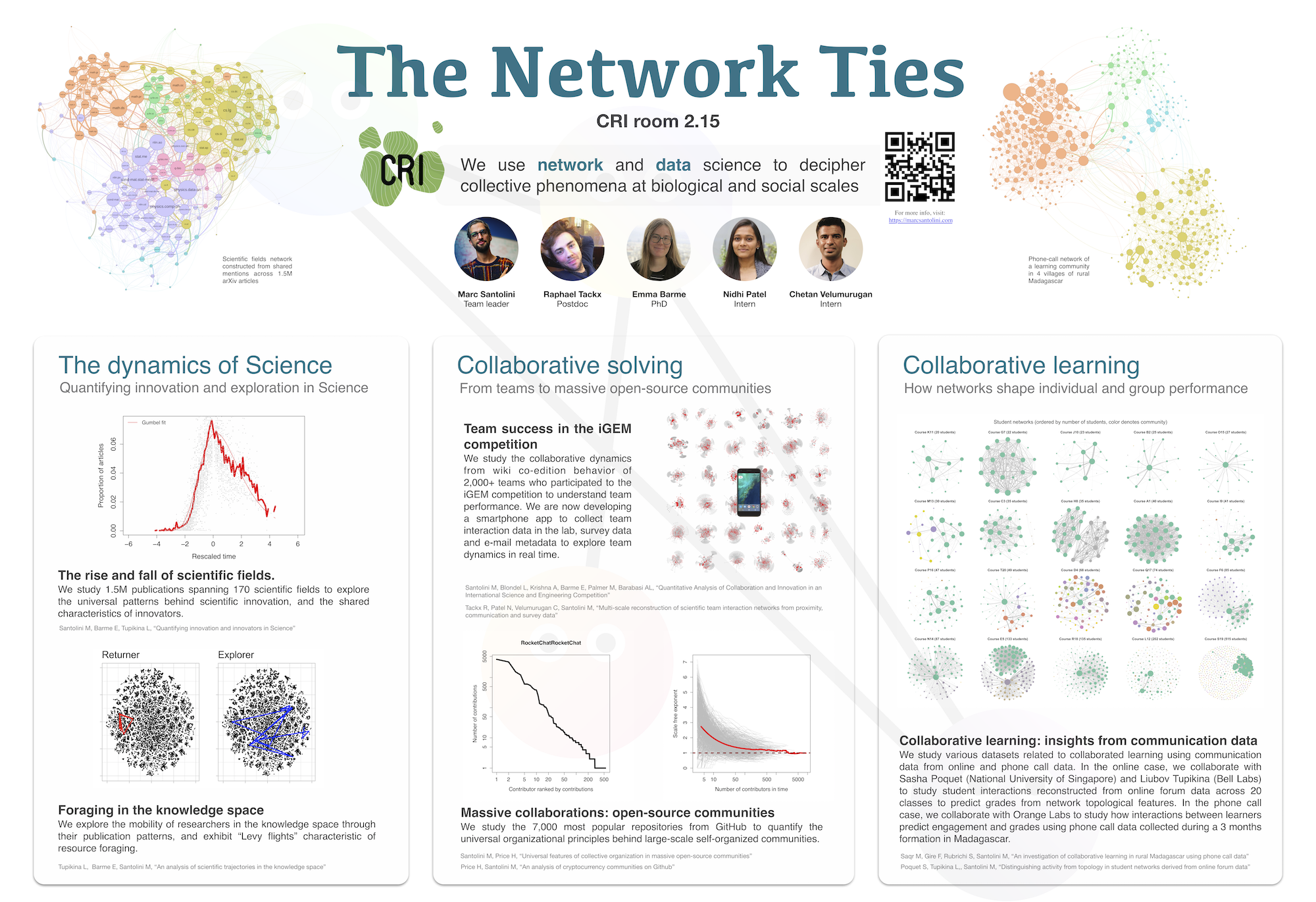
A lot has happened since I started my lab last year, and I wanted to showcase a bunch of projects that we have begun to tackle at CRI with my team, the Network Ties! Below you can find a poster presenting our work in quantifying innovation and large-scale collaboration in science and technology. These various projects combine physics-inspired modeling, network and data science to better understand how collective intelligence shape both learning and solving! If you’re interested in these projects, we are hiring! Do not hesitate to contact me for further information!
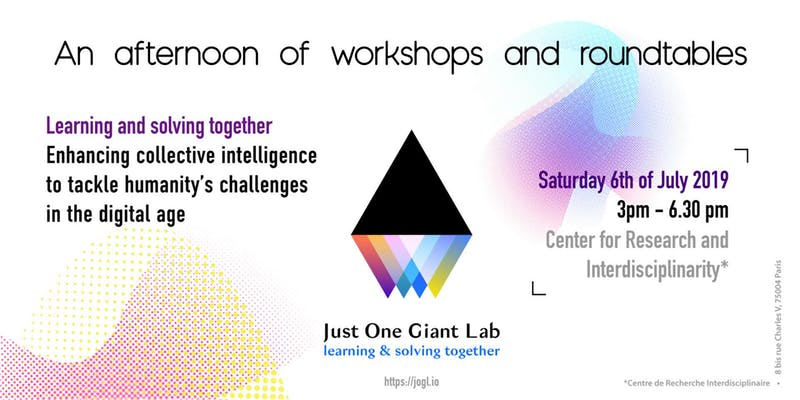
For the first event after its launch last week, I am happy to invite you with Just One Giant Lab (JOGL) to an afternoon of round tables and workshops to open the collaboration around the construction of JOGL itself.
|| On the agenda ||
During this very special event, experts in open science, collective intelligence, social impact and platform design will share their experience and exchange with the participants around two round tables and a workshop.
The first round table will open discussions about how to enhance collective intelligence for social impact. In particular, how we can facilitate “giant” collaborations around the globe. The second round table will reflect on how to design digital platforms to implement collective intelligence at scale, in the context of open science. After a coffee break, the afternoon will end with a workshop where participants will have the possibility to test the JOGL platform, provide feedback and share with the team what features they would dream to see on JOGL.
The idea? JOGL is a platform with a strong vision but a design in constant construction. This event aims to give the opportunity to all to participate in this design and help build the future of the JOGL platform. As such, feedback shared by participants will be taken into consideration to serve as a roadmap for the implementation of the upcoming features of JOGL and make it the platform everyone needs.
Continue reading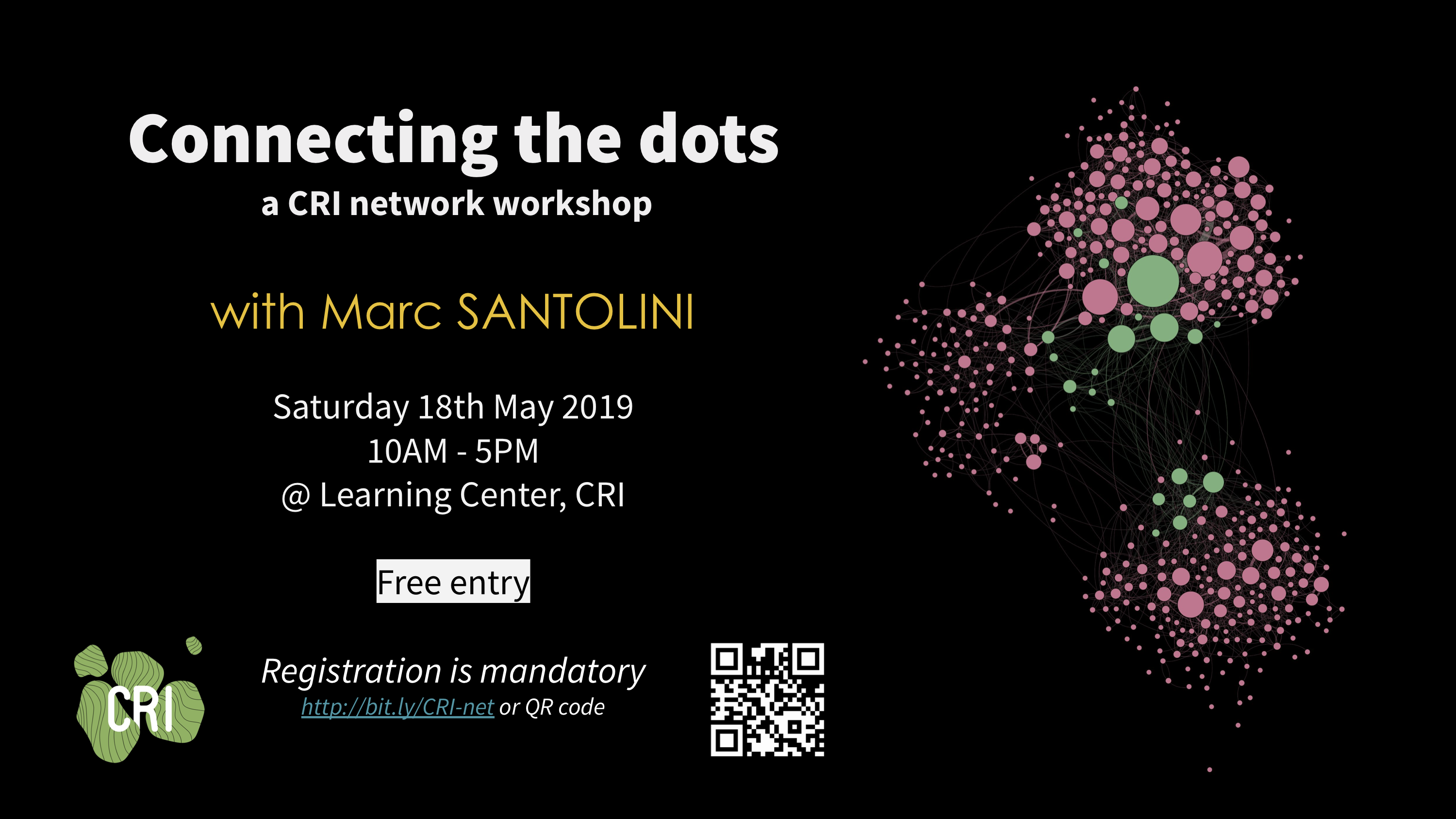
On Saturday 18th May I will organise a network workshop at the CRI! It is intended to be a hands-on experience learning about, mining, manipulating, describing and visualizing networks. It will take place in the learning center of the CRI from 10am to 5pm.
To register to the event, go to the event page! The workshop requires no background or prior experience in Network analysis. Just make sure to bring your MOTIVATION to learn and build your own network! It is intended for learners of all levels (bachelors, masters, PhD). We are open to welcome people outside from CRI as well. Please make sure you have registered for the event. You will be expected to participate actively in the activities of the workshop. Please bring your laptop for the workshop, as you will use them for the hands-on experience. If you do not have a laptop, please inform us so that we can try and find one for you!
I have visited the Santa Fe Institute for Complex Systems from Wednesday 20 Feb to Friday 22 Feb. This was the occasion to discuss potential projects with future CRI fellow and “network archeologist” Stefani Crabtree, as well as discover this fantastic place in the desert mountains of New Mexico!
 Marc Santolini